


INSIGHTS / Foundation Models & Learning
What Comes Next for AI?
Five open questions from the Tsinghua AI Research Exchange, spanning autonomous learning, compute efficiency, real-time interaction, physical-world understanding, and verifiable reasoning.

Across the presentations, five questions stood out as priorities for the research community:
- Can AI learn autonomously and continue to improve through use? The goal is to make models less dependent on human labels and expert feedback, and better able to learn from what happens during actual use.
- Can we get more intelligence from the same amount of compute? Lower numerical precision, alternative generation methods, and smarter allocation of computation could change the economics of training and deploying AI.
- Can AI understand what people mean and work with them over time? This requires following a conversation as it unfolds, interpreting changing visual and audio cues, and knowing when to speak or act.
- Can AI learn about the physical world by interacting with it? Robots need to gather information that vision alone cannot provide and turn those interactions into experience they can use for learning and decision-making.
- How do we make AI reasoning trustworthy and knowledge reusable? Systems must preserve the meaning of the original problem, verify their results, and organize existing knowledge so that future work can build on it.
I. Learning from Experience
Ruoyu Sun | Learning from a Model’s Own Outputs
Background: Associate Professor in the School of Data Science at the Chinese University of Hong Kong, Shenzhen; previously Assistant Professor at UIUC and full-time Visiting Scientist at FAIR. His work focuses on deep learning optimization and foundation model training.
Research takeaways
-
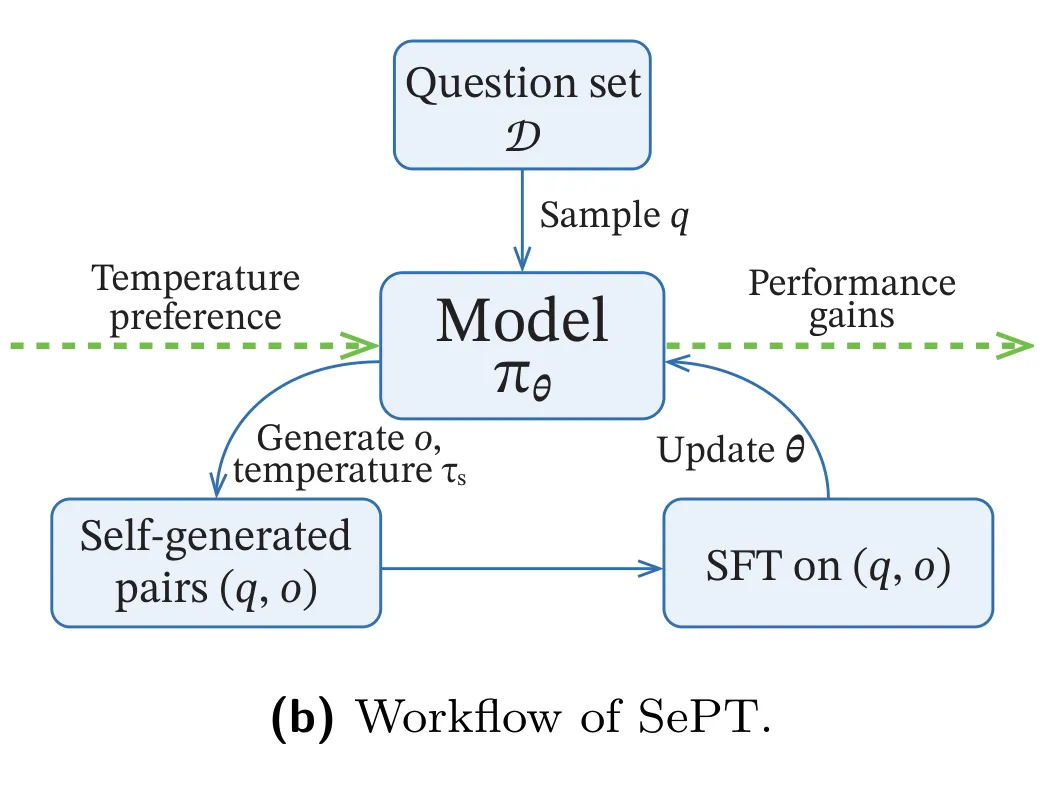
Improving a model’s reasoning usually requires some external signal: a correct answer, a score, or expert feedback. These signals can be difficult and expensive to obtain, particularly in specialist domains. SePT investigates whether a model can continue improving with less external supervision by training on its own responses.
-
The process is iterative. A model generates a set of worked solutions, trains on those solutions, and then uses its updated capabilities to generate the next batch. During generation, randomness is reduced to keep the outputs more focused.
-
The training examples are not first screened for correct answers. Even so, the method produced improvements across several base models and six mathematics benchmarks. Some of those gains went beyond what could be achieved simply by making generation less random.
-
The results are more encouraging in mathematics than in commonsense reasoning. Performance can also deteriorate after repeated rounds. The work shows promise, but sustained, reliable self-improvement remains an open question.
Our take
- The most interesting implication is the potential to reduce the amount of expert supervision needed for specialist tasks. If the approach transfers to those settings, experts could spend less time answering individual questions and more time choosing the right problems and defining what a satisfactory result looks like.
- The next tests are whether gains hold up over repeated training cycles and whether they extend beyond mathematics. Fields where expert feedback is particularly costly would be natural places to start.
Xuanhe Zhou | Automating the Model Improvement Cycle
Background: Assistant Professor in the School of Computer Science at Shanghai Jiao Tong University, with a PhD from Tsinghua University. His research focuses on intelligent data systems and self-improving agents.
Research takeaways
- When a model or agent fails, improving it usually involves a familiar sequence: review the failure, diagnose the cause, add data or change the configuration, and test again. Much of this work is repetitive, but it still depends heavily on human judgment.
- This research aims to automate that cycle. The system first identifies the source of a failure. Was relevant information missing? Was a tool’s response ambiguous? Or does the model lack a capability needed for the task? The diagnosis then determines the intervention.
- Possible interventions include collecting harder examples, acquiring missing knowledge, and creating additional training data. The system can also search for more efficient operating configurations, check whether they compromise performance, and generate new evaluation tasks.
- The central challenge is getting the diagnosis right and having evaluations that catch problems early. Without those foundations, additional data, configuration changes, and retraining may do little to address the actual failure.
Our take
- The clearest near-term opportunity is in the development and maintenance of models and agents. Teams repeatedly spend time reviewing failures, preparing data, and retesting changes. A product that reduces that workload or shortens the improvement cycle has value that customers can measure.
- Enterprise agents are a promising setting, especially where tasks recur, execution can be traced, and outcomes can be checked. Such systems could collect failures during deployment and test whether subsequent changes resolve them. Lower ongoing maintenance costs would create a concrete reason for customers to pay.
Liyuan Wang | Learning New Skills Without Losing Old Ones
Background: Assistant Professor in Tsinghua University’s Department of Psychological and Cognitive Sciences, with an interdisciplinary background in life sciences and computer science. His research draws on biological learning and memory to help AI adapt while retaining existing capabilities.
Research takeaways
- An AI system deployed in the real-world encounters changing tasks and environments. It needs to learn from those changes without erasing what it already knows. This tension between adaptation and retention is the central problem of continual learning.
- One approach takes inspiration from sparse representations and specialized modules in the fruit fly brain. Different parts of the system separately handle rapidly changing information and more durable experience, limiting how much of the model needs to change each time it learns.
- Memory also serves different purposes. Working memory supports the task at hand. Long-term memory stores selected experiences. The most important and reliable lessons may eventually be incorporated into the core model. Each step presents a separate challenge: keeping an experience, finding it again, and learning to apply it are different capabilities.
- For robots, spatial experience can be organized into landmarks, routes, and maps. This gives them a way to use past observations, avoid exploring the same areas repeatedly, and coordinate tasks across locations and goals.
- Early control experiments suggest that these methods are particularly useful when the environment is disturbed or the robot’s physical characteristics change. Two major challenges remain: turning externally stored experience into reliable model capability and learning new tasks without forgetting previous ones.
Our take
- The value of accumulated experience should be most visible in products that serve the same person, organization, or environment over time. Useful indicators include fewer recurring mistakes and less tuning when the system encounters a new setting.
- A memory system becomes a product advantage when past experience improves future performance. A larger archive and better retrieval are only part of that process; the system also needs to develop skills it can apply reliably.
II. Making Models More Efficient
Hongxia Yang | Lower Training Costs Through Model Fusion and Low Precision Computation
Background: Chair Professor of Generative Artificial Intelligence at the Hong Kong Polytechnic University. She previously led ByteDance’s large-model efforts in the United States and served as an AI Scientist and Director at Alibaba. Her research focuses on low-cost training and combining capabilities from independently developed models.
Research takeaways
- Training large models is expensive, and valuable data in sectors such as healthcare and energy is often spread across institutions. This work approaches the problem from two directions: reusing capabilities that already exist in other models, and reducing the computation required to train and run them.
- Co-GenAI explores how models trained separately in different domains can be combined. Where the necessary parameters and other prerequisites are available, the aim is to preserve and bring together existing capabilities, avoid redundant training, and make the outcome of model fusion more predictable.
- Low-precision computation addresses the resource side. Representing numerical values with fewer bits, as in FP8 and FP4, can reduce memory use and computation. Making this work requires coordination across training algorithms, low-level implementations, and the wider system. RL introduces an additional complication when training and inference use different numerical precision.
- For areas where data are hard to pool, one possible path is to train specialist models locally and then combine their capabilities. Success depends on retaining each model’s expertise and making the process repeatable.
Our take
- Organizations in specialized industries may be able to develop the capabilities they need without funding a complete general-purpose model. Building expertise around a specific problem and then drawing on other models could offer a more manageable cost structure.
- The results need to be assessed separately in each domain. A higher overall score can conceal a loss of specialist capability. For a startup, the ability to preserve that expertise reliably across customer environments will matter more than a successful one-off demonstration.
Jianfei Chen | Understanding Why Low-Precision Models Still Work
Background: Associate Professor in Tsinghua University’s Department of Computer Science and Technology, with bachelor’s and PhD from Tsinghua. His research focuses on efficient machine learning and quantization; representative work includes ActNN.
Research takeaways
- Using fewer bits to represent values inside a model saves memory and compute. The underlying question is how much numerical detail can be removed before the model’s output suffers and why it tolerates some of that loss in the first place.
- In the Transformer language models studied, training enables the network to offset some errors across layers. Quantization errors therefore build up more slowly than they do in a randomly initialized network, offering one explanation for the robustness of trained models.
- The analysis also suggests that, under certain conditions, tokens the model already strongly favors are less sensitive to numerical perturbations. Small computational errors may leave the final output choice unchanged.
- Training itself is noisy because each update is based on only a portion of the data. When quantization errors are sufficiently small and do not introduce systematic bias, their effect may be weaker than the variability already present in the training process.
- These findings have limits. Reducing precision further can still cause errors to rise sharply, and the mechanisms through which training creates this tolerance are not yet fully understood.
Our take
- For training and inference providers, low precision matters to the extent that it reduces the cost of delivering a given level of quality. Memory savings, compute savings, and operating costs need to be measured across the complete workflow.
- Commercial viability also depends on compatibility. Supporting a broad range of models, hardware, and workloads affects both deployment effort and the size of the customer base. A strong result on one model is an encouraging starting point, but wider adoption requires consistent performance across those settings.
Chongxuan Li | A Different Way to Generate Language
Background: Associate Professor in the Gaoling School of Artificial Intelligence at Renmin University of China. His research covers generative model theory, training, and efficient sampling. The presentation used LLaDA to examine the potential of diffusion language models.
Research takeaways
-
Most language models write from left to right, with each new token depending on those already generated. LLaDA explores a different process: working on several parts of a response at once and gradually filling in the whole.
-
During training, the model learns to reconstruct masked text using the surrounding context. For example, it might recover the missing word “China” from the sentence “Beijing is the capital of ___.”
-
At generation time, the model begins with blank positions and fills them over several rounds. It can start with the positions it is most confident about, then use the emerging context on both sides to complete or revise the remaining text.
-
This creates opportunities for parallel generation. However, the model still needs repeated passes. Whether the approach delivers an overall speed advantage depends on how many passes are required to reach the desired quality and how well the inference system supports the process.

Our take
- Good initial use cases include tasks where users need a complete result quickly and quality is straightforward to assess. Text completion and editing that benefit from context on both sides are also worth testing.
- The relevant comparison is the total time and cost needed to finish a task at equivalent quality. Greater parallelism within one pass only creates value if it improves the full generation process.
Gen Li | Connecting Continuous Generation to Discrete Text
Background: Assistant Professor in the Department of Statistics and Data Science at the Chinese University of Hong Kong, with a PhD from Tsinghua University. His research covers diffusion models, generative AI, and reinforcement learning. The presentation introduced ConvergeFlow.
Research takeaways
- Models represent text internally as numerical vectors. Continuous language generation tries to generate those vectors directly before turning them into text, providing another route to approaches such as parallel generation.
- The difficulty is that a generated vector may fall between valid token representations. Additional correction or conversion steps are then needed to produce an actual token from the vocabulary.
- ConvergeFlow changes the prediction structure so that outputs are weighted combinations of existing token representations. Under the conditions established in the research, the generation process is guaranteed to converge to a representation corresponding to a vocabulary token.
- Experiments so far have used models around GPT-2 Small scale and sequences of 1,024 tokens, examining the trade-off between parallel generation and text quality. The approach still needs to be tested at larger scales.
Our take
- This work addresses a foundational issue: how to turn continuous representations into valid text. Fluency and reasoning accuracy remain separate questions.
- Its practical value will depend on the full generation process. At larger scales, we would want to know how much time and computation are saved by removing additional conversion steps, and whether those savings come with any loss in quality.
Cheng Yang | Bringing Large-Model Understanding Capabilities into Search and Recommendation
Background: Associate Professor in the School of Computer Science at Beijing University of Posts and Telecommunications, with bachelor’s and PhD degrees from Tsinghua University. His research spans recommendation systems, graph learning, and large models.
Research takeaways
- Search and recommendation services handle large request volumes under tight cost and latency constraints. Running complex large-model reasoning for every request would be expensive. The challenge is to capture the benefits of richer understanding within the economics of a production service.
- One approach uses a model to encode user needs, queries, and product information into representations that existing retrieval systems can compare efficiently. Computation for common queries can be performed in advance and reused.
- Another approach uses user histories and product information to infer preferences ahead of time, then passes those insights to lightweight models serving live requests. This may be especially useful for users or products with limited interaction data.
- Generative retrieval changes how the candidate set is produced. Products or content are assigned codes, and the model generates those codes directly. Related work explores longer user histories, multimodal inputs, and a single model that can support several different use cases.
Our take
- Recommendation quality and serving economics need to improve together. Performing expensive reasoning in advance and reusing the results across many requests offers a practical way to spread the cost. Users and products with little interaction data provide a useful test of whether large models contribute additional value.
- Sustained progress will also depend on access to long-term behavioral data, how the product catalog is represented, and the team’s ability to run online experiments. Ultimately, better models need to translate into better business results.
Cong Fang | Why Larger Models Can Be Easier to Train
Background: Assistant Professor and Researcher in Peking University’s School of Intelligence Science and Technology, with a PhD from Peking University and postdoctoral experience at Princeton University and the University of Pennsylvania. His research focuses on deep learning theory and optimization.
Research takeaways
- A small model may have enough theoretical capacity to solve a problem while still being difficult to train. Model size therefore needs to be considered alongside the ability of an optimization algorithm to find the right solution.
- Using simplified problems such as Tensor PCA, the research examines how additional parameters change the search space. In certain settings, a larger parameter space makes the target easier to find and reduces the amount of data required.
- The training method also shapes which capabilities emerge and when. Under the conditions studied, stochastic gradient descent tends to learn stronger signals first. Some constraints encourage the discovery of a broader set of features early on, but can hinder fitting if maintained later in training.
- This motivates training schedules that adjust those constraints over time. The results offer insight into how learning works, although conclusions from simplified mathematical settings do not directly identify the optimal size of a large language model.
Our take
- Small-model and compression projects should be evaluated on the total cost of reaching the required capability: training, data, and inference together. If a smaller model is harder to train or needs more data, some of its expected savings may be lost.
- Model size and training strategy need to be chosen together. For any specific project, actual training results remain essential to understanding the economics.
III. Understanding Intent and Interacting in Real Time
Minlie Huang | Voice Agents That Understand Context and Follow Through
Background: Professor in Tsinghua University’s Department of Computer Science and Technology. His longstanding research interests include natural language generation, dialogue systems, and social intelligence.
Research takeaways
- Real conversations are messy. Users may be unsure what they want, change their minds, interrupt, or speak from noisy surroundings. Evaluations presented at the event showed that voice agents still perform worse than text agents at completing tasks, with background noise widening the gap.
- Understanding a spoken sentence requires more than recognizing its words. The relationship between the speakers, the surrounding conversation, and the stage of the task all matter. “Whatever,” for example, might express agreement or frustration, and the appropriate response would differ accordingly.
- Full-duplex interaction allows a system to listen while speaking, handle interruptions, and return to the task afterward. One architecture assigns immediate interaction to a lightweight model and more demanding reasoning to a backend model, helping the conversation stay responsive while the task continues.
- Delivery matters too: emphasis, pauses, pace, and intonation all affect communication. Recognizing emotion is useful when it helps the agent choose what to say or do next.
Our take
- Education, customer service, and companion products often begin by clarifying a need and then work toward a resolution over several exchanges. Context awareness, interruption handling, and the ability to resume a task will determine how much of that process voice agents can manage.
- The practical evidence of better emotional understanding would be users having to repeat themselves less, correct the system less often, and rely less on human intervention. Those outcomes offer a more useful measure of product performance than the number of emotion categories recognized.
Yuan Yao | Models That Keep Listening and Watching While They Respond
Background: Assistant Professor in Tsinghua University’s School of Artificial Intelligence, with a PhD from Tsinghua. He leads the development of ModelBest’s MiniCPM-V and MiniCPM-o series, focusing on efficient multimodal models and continuous audiovisual interaction.
Research takeaways
- A model that answers questions about a single image or audio clip faces a much simpler problem than one participating in an ongoing interaction. In the latter, sights, sounds, and user behavior change continuously. The model must keep taking in information even while speaking and adjust as the situation develops.
- OmniFlow aligns visual, audio, and language signals along a shared timeline and processes them in short, interleaved segments. This helps the model track what happened when and decide whether to speak, how much to say, or when to wait.
- Training requires data that captures the distinctions found in real conversation. A brief acknowledgment, a request to stop, and unrelated background speech can sound similar but call for different behavior. The model needs context to judge what matters and whether its response should change.
- The architecture connects a backbone model with lightweight modules for different modalities in an end-to-end system. This aims to balance responsiveness and capability with operating cost. Training across modalities can also interfere with existing skills if not handled adequately, while continuous operation creates further demands on latency and resources.
Our take
- The approach is particularly relevant to proactive assistants and smart devices that must remain aware of their surroundings. A system that follows events as they happen could reduce the need for users to keep describing the situation and issuing new instructions.
- Evaluation should reflect that continuity: can it stay on task through noise, overlapping speakers, or an interruption while it is talking? Long-duration power consumption, cost, and stability are equally important.
IV. Learning About the Physical World
Yunbo Wang | Building Trainable Simulations from Real Environments
Background: Associate Professor at Shanghai Jiao Tong University, with a PhD from Tsinghua University. He studies world models, physical reasoning, and model-based reinforcement learning, and leads the NeoWorld project.
Research takeaways
-
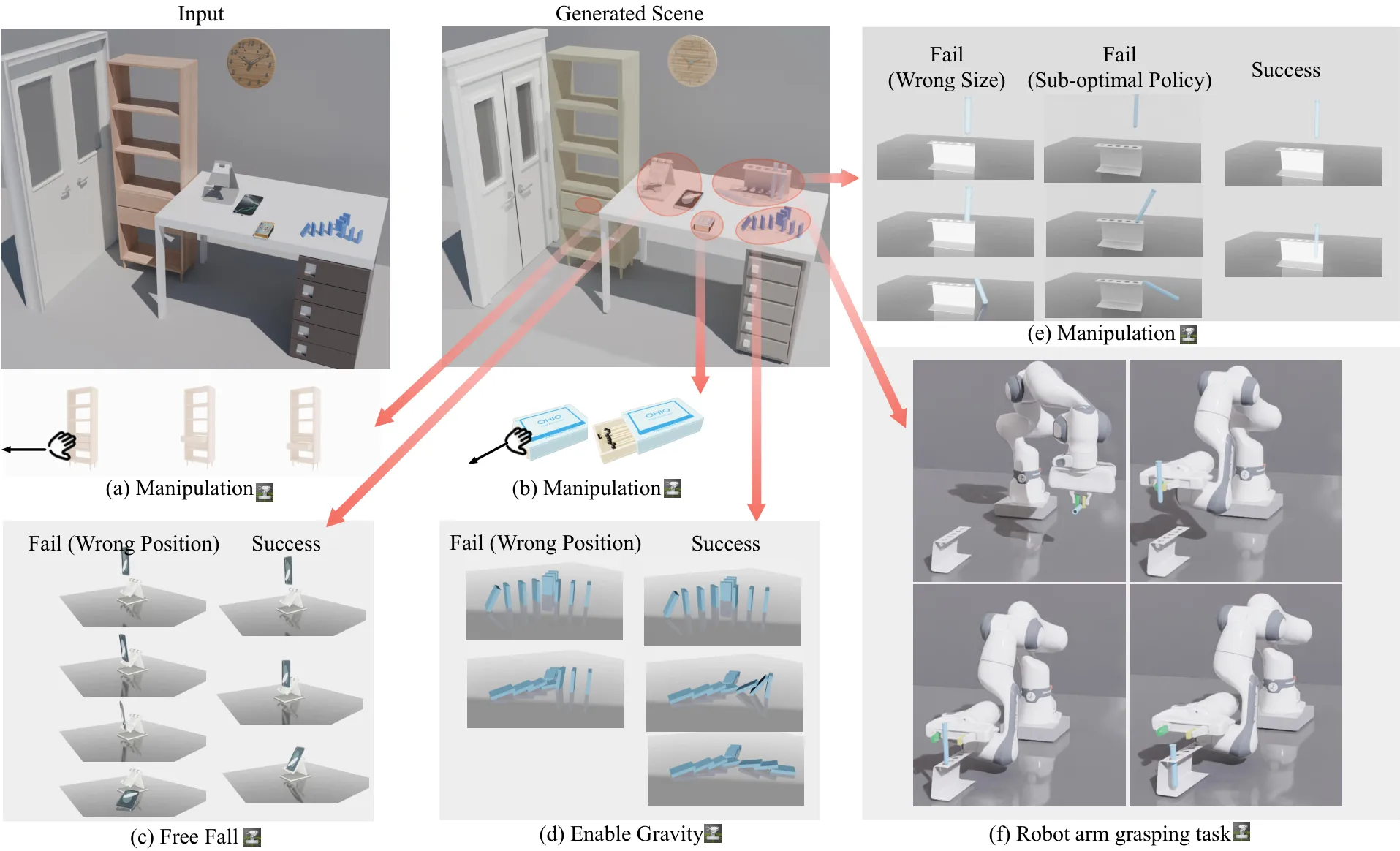
Training robots on new tasks often requires expensive data collection with physical hardware. Simulation offers a way to practice repeatedly, provided that the simulated objects can move, be manipulated, and behave sufficiently like their real counterparts.
-
NeoWorld-Pro aims to create interactive objects from a single image, reconstructing their geometry, joints, and assembly structure. Rendering, motion tests, and physical checks are then used to identify and fix problems such as intersecting objects, unstable placement, or incorrect dimensions.
-
OrbiSim models what happens next given the current scene and an action. It is trained first on simulated data, then adjusted using the movement of real objects. It can also help infer unknown physical properties.
-
Deployment requires an ongoing process of calibration. Once a robot completes a subtask, the positions and states of objects may have changed, so the simulation needs to be brought back into alignment. General-purpose models mainly support scene understanding, task decomposition, and planning; difficult contact-rich operations still require specialized control policies.
-
With complete information about scene and object states, success rates on some simulated pick-and-place tasks can approach 90%. Complex iterations, however, may take several hours. Real environments provide incomplete information, and properties such as friction and damping are difficult to recover from a single image, making estimation and calibration necessary.
Our take
- The economic case for simulation depends on how much physical data collection and robot tuning it eliminates. That saving needs to be weighed against the work required to build the simulation, estimate physical parameters, and keep it calibrated.
- Failures are useful data. Picking up the wrong object, colliding with something, or failing a manipulation records what an action actually caused in the physical world. Accumulating that experience could be valuable if it helps robots perform specific operations reliably across different environments.
Ruoxuan Feng | Robots That Act to Find Out What They Need to Know
Background: PhD student in the Gaoling School of Artificial Intelligence at Renmin University of China, supervised by Professor Di Hu, and a contributor to the ROMA and AnyTouch research series. The work combines vision, hearing, touch, and force feedback for active perception.
Research takeaways
-
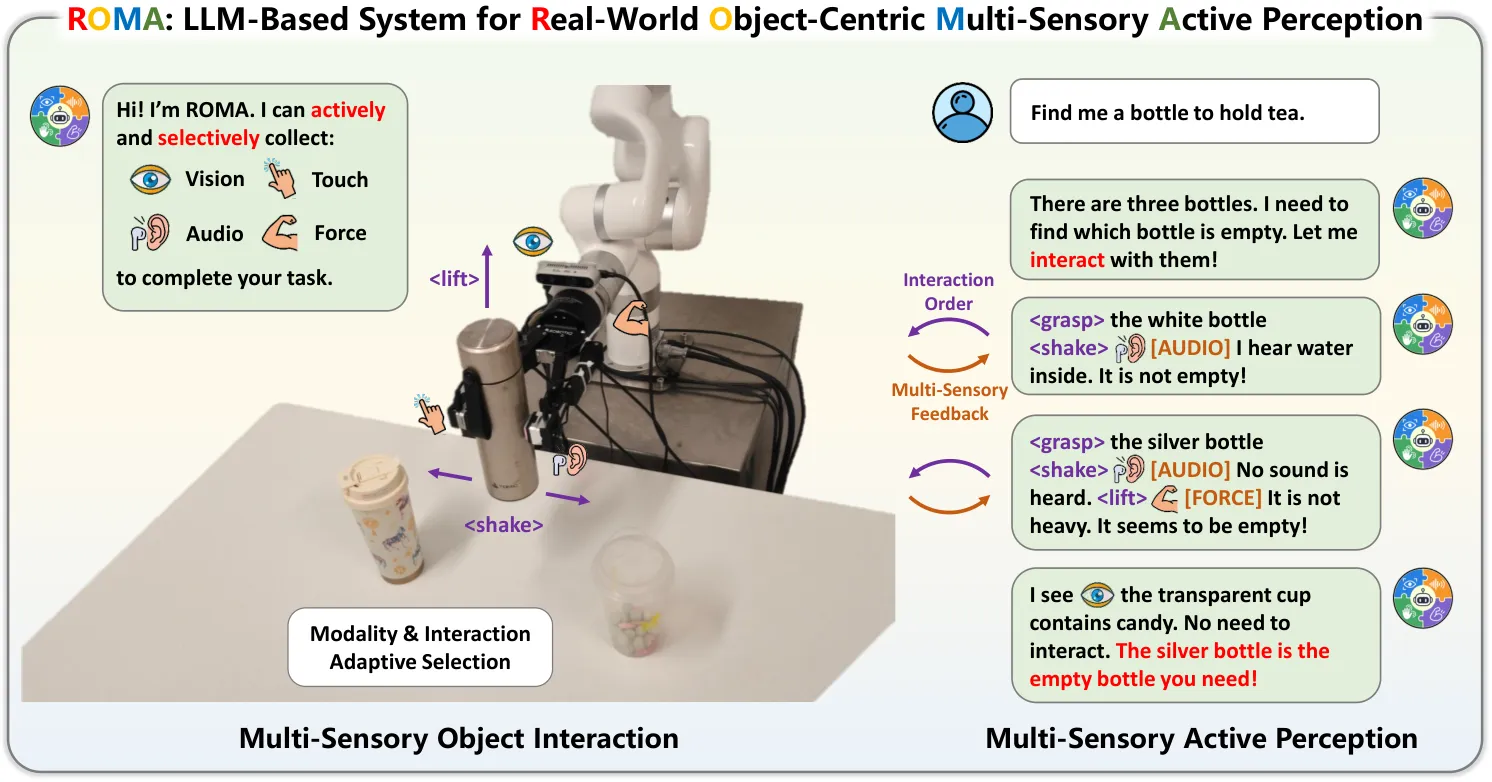
Some properties cannot be established by visuals alone. A robot may need to know how heavy an object is, whether it is soft, or what is inside a container. It must identify the missing information, choose an action such as lifting, pressing, or shaking, and use the resulting feedback to update its understanding.
-
ROMI-2K captures nearly 2,000 combinations of objects and contents across six types of basic interaction, with visual, audio, tactile, and force measurements. Evaluation uses objects that were not seen during training to test generalization.
-
ROMA turns information gathering into a sequence of decisions. At each step, it chooses an object, an action, and a sensory channel, then decides whether it knows enough. To determine whether the heaviest object is empty, for instance, it can first identify the heaviest item and then inspect its contents, avoiding unnecessary interactions with other objects.
-
An action must be appropriate for the measurement being sought. Force readings during vigorous shaking may be poor evidence of weight, and actions such as pressing or shaking also require a stable grasp.
-
On some tasks, a small model can compensate for limited visual information by interacting more effectively. It still trails stronger general-purpose models in language understanding and open-ended question answering.
Our take
- For tasks involving weight, softness, or hidden contents, additional sensory information may be essential to success. The key questions are whether the robot can choose an informative action for an unfamiliar object and whether it can gather enough evidence efficiently.
- There may also be a connection to simulation. Measurements of weight or resistance obtained through active perception could help calibrate a world model, allowing one interaction to improve both the immediate decision and subsequent training. This is a hypothesis drawn from the two research directions and still needs to be tested in an integrated system.
V. Verifiable Reasoning and Reusable Knowledge
Tao Luo | Proving the Right Problem and Building on Existing Mathematics
Background: Associate Professor in the School of Mathematical Sciences at Shanghai Jiao Tong University, with a PhD in mathematics from the Hong Kong University of Science and Technology. His research covers the mathematical foundations of machine learning and AI for mathematics.
Research takeaways
- Formalizing mathematics means expressing problems and proofs in a precise language that a computer can check step by step. But verification begins before the proof itself: the formal statement must accurately capture the problem originally posed.
- A seemingly small translation error can change what is being proved. Replacing “every real number” with “every positive number” narrows the claim. A valid proof of that narrower statement would leave the original problem unresolved.
- The research explores breaking statements into structured components so that the objects, assumptions, and conclusions can be checked more systematically. Errors can then be located and corrected at the relevant part of the statement. The same structure can help organize training examples in increasing order of difficulty.
- The work also extends to knowledge bases spanning multiple documents. Definitions, theorems, proofs, and their dependencies need to be connected; similarly named results with different assumptions need to be distinguished; and duplicate concepts need to be consolidated. Together, these steps make prior mathematical work easier to find and reuse.
Our take
- Reliable mathematical AI requires two checks: whether the system has faithfully represented the question, and whether it has proved that statement correctly. Formal proof systems address the second, but do not by themselves guarantee the first.
- A structured mathematical knowledge base could become a standalone product if it reduces repeated expert checking and formalization while enabling dependable reuse of existing work. Extending the approach to other specialist fields would likewise require a clear definition of correctness and a practical way to verify it.